Tag Archives: George Harrison

The Beatles: Help

Help

On August 6, 1965, “Parlaphone” label released “Help!”, the fifth Beatles (The) studio album and the soundtrack from their movie with the same title. It was recorded February – June 1965, at “EMI Studios” in London, and was produced by George Martin. Seven from the total fourteen album songs, including “Help!” and “Ticket to Ride”, appeared in the movie. and took up the first side of the vinyl album. The album also included “Yesterday”, the most-covered song in the history of popular music. “Rolling Stone” magazine ranked the album at number 331 on its list of the “500 Greatest Albums of All Time”.

Personnel:

  • John Lennon– lead, harmony and backing vocals, rhythm guitar, electric piano
  • Paul McCartney– lead, harmony, and backing vocals, lead and bass guitars, acoustic and electric pianos, güiro
  • George Harrison– lead, harmony and backing vocals, lead and rhythm guitars
  • Ringo Starr– lead vocals, drums, miscellaneous percussion
  • George Martin– piano
  • John Scott– tenor and alto flutes
  • Sidney Sax – violin
  • Tony Gilbert – violin
  • Kenneth Essex – viola
  • Francisco Gabarro – cello
  • String quartet on “Yesterday”, arranged by George Martin and Paul McCartney
  • Robert Freeman – photography

Track listing:

All tracks by John Lennon and Paul McCartney, except where noted.

  1. Help!
  2. The Night Before
  3. You’ve Got To Hide Your Love Away
  4. I Need You
  5. Another Girl
  6. You’re Going To Lose That Girl
  7. Ticket To Ride
  8. Act Naturally
  9. It’s Only Love
  10. You Like Me Too Much
  11. Tell Me What You See
  12. I’ve Just Seen A Face
  13. Yesterday
  14. Dizzy Miss Lizzy

The Beatles: Revolver

Revolver

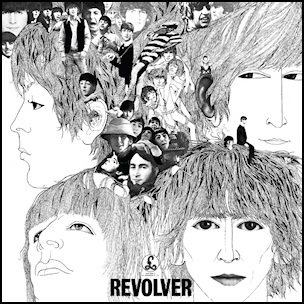
On August 5, 1966, “Parlaphone” released “Revolver” the seventh Beatles (The) album. It was recorded April – June 1966, at “EMI Studios” in London, and was produced by George Martin. The album was recognized by critics as having redefined the parameters of popular music. The album’s Grammy Award-winning cover design was created by Klaus Voormann, old band’s friend from their early years in Hamburg. “Rolling Stone” magazine ranked “Revolver” at number three on its list of the “500 Greatest Albums of All Time”.

Personnel

  • John Lennon– lead, harmony and backing vocals, rhythm and acoustic guitars; piano, Hammond organ, harmonium; tape loops, sound effects; cowbell, tambourine, maracas, handclaps, finger snaps
  • Paul McCartney– lead, harmony and backing vocals, bass, acoustic and lead guitars; piano, clavichord; tape loops, sound effects; handclaps, finger snaps
  • George Harrison– lead, harmony and backing vocals, lead, acoustic, rhythm and bass guitars; sitar, tambura; tape loops, sound effects; maracas, tambourine, handclaps, finger snaps
  • Ringo Starr– lead vocals, drums; tambourine, maracas, handclaps, finger snaps; tape loops
  • Mal Evans– bass drum, backing vocals
  • Anil Bhagwat – tabla
  • Peter Coe, Alan Branscombe– tenor saxophone
  • Eddie Thornton, Ian Hammer, Les Condon – trumpet
  • Alan Civil– French horn
  • Geoff Emerick- tape loops of the marching band
  • George Martin– piano, Hammond organ, tape loops of the marching band
  • Tony Gilbert, Sidney Sax, John Sharpe, Jurgen Hess
  • Stephen Shingles, John Underwood – viola
  • Derek Simpson, Norman Jones – cello
  • Brian Jones – backing vocals
  • Donovan– backing vocals
  • Marianne Faithfull– backing vocals
  • Neil Aspinall– backing vocals
  • Pattie Boyd– backing vocals

Track listing

All tracks by John Lennon and Paul McCartney, except where noted.

  1. Taxman – George Harrison
  2. Eleanor Rigby
  3. I’m Only Sleeping
  4. Love You To – George Harrison
  5. Here, There and Everywhere
  6. Yellow Submarine
  7. She Said She Said
  8. Good Day Sunshine
  9. And Your Bird Can Sing
  10. For No One
  11. Doctor Robert
  12. I Want To Tell You – George Harrison
  13. Got To Get You Into My Life
  14. Tomorrow Never Knows

Billy Preston

On June 6, 2006, William Everett “Billy” Preston, died aged 59. He was musician (keyboards, Hammond organ), Grammy-winning artist,  recorded and performed with some of the greatest names in the modern music history, including the Beatles, the Rolling Stones, Sam Cooke, Nat King Cole, Little Richard, Ray Charles, George Harrison, Elton John, Eric Clapton and Bob Dylan. Preston also had a successful solo career, his best known songs include “That’s the way God planned it”, “Outa-Space”, “Will it go round in circles”, “Space Race”, and “Nothing from nothing”.

Gary Moore

On February 6, 2011, Gary Moore died aged 59. He was musician (guitar, bass, keyboards), vocalist and songwriter,  member of Skid Row, Thin Lizzy, Colosseum II, G-Force, Scars and BBM. He recorded and performed with many famous artists including Greg Lake, George Harrison, Rod Argent, B.B. King, Andrew Lloyd Webber, The Beach Boys, Gary Boyle, Dr. Strangely Strange and Travelling Wilburys.  As solo artist he released 17 albums.

George Harrison: The Apple Years 1968 – 1975

George Harrison

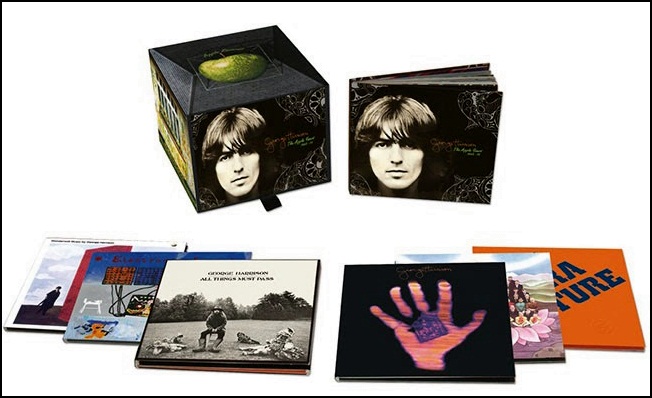
On September 23, 2014, “Universal Music Group” label released “George Harrison – The Apple Years 1968-1975”,  a seven CD box with  some of the most popular George Harrison solo albums. The seven CD’s plus an 40-minute DVD box contains the following albums:

“Wonderwall Music”

“Electronic Sound”

“All Things Must Pass”

“Living in the Material World”

“Dark Horse”

“Extra Texture

The DVD contains a short music movie named “The Apple Years” and videos and short documentaries about Harrison’s albums featured in the CD box. Dhani Harrison (George Harrison’s son) is the executive producer and together with  the engineer Paul Hicks have remastered the sound from the original analogue tapes.

The Concert for Bangladesh

zx

“The Concert for Bangladesh” were actually two benefit concerts organized by George Harrison and Ravi Shankar, held at 2.30 and 8 pm on Sunday, August 1, 1971, playing to a total of 40,000 people at Madison Square Garden in New York City. The shows were organized to raise international awareness and fund relief efforts for refugees from East Pakistan (now Bangladesh), following the Bangladesh Liberation War-related Bangladesh atrocities. The concerts were followed by a live album, a boxed three-record set, and “Apple Films” concert documentary, which opened in cinemas in the spring of 1972. The event was the first-ever benefit concert of such a magnitude and featured a supergroup of performers that included Harrison, Ringo Starr, Bob Dylan, Eric Clapton, Billy Preston, Leon Russell and the Badfinger. In addition, Shankar and Ali Akbar Khan – both of whom had ancestral roots in Bangladesh – performed an opening set of Indian classical music. Decades later, Shankar would say of the overwhelming success of the event: “In one day, the whole world knew the name of Bangladesh. It was a fantastic occasion”.

The concerts raised close to US$250,000 for Bangladesh relief, which was administered by UNICEF. Although the project was subsequently marred by financial problems – a result of the pioneering nature of the venture – the “Concert for Bangladesh” is recognized as a highly successful and influential humanitarian aid project, generating both awareness and considerable funds as well as providing valuable lessons and inspiration for projects that followed, notably Live Aid. By 1985, through revenue raised from the “Concert for Bangladesh” live album and film, an estimated $12 million had been sent to Bangladesh in relief. Sales of the live album and DVD release of the film continue to benefit the George Harrison Fund for UNICEF.

The Beatles: Sgt. Pepper’s Lonely Hearts Club Band

12

On May 26, 1967, “Parlaphone” label released “Sgt. Pepper’s Lonely Hearts Club Band”, the eighth Beatles (The) studio album. It was recorded 24 November 1966 – 21 April 1967, at “EMI Studios” and “Regent Sound Studio” in London, and was produced by George Martin. The album is regarded as the first concept and art album in popular music. “Time” magazine described it as “a historic departure in the progress of music” It was an immediate commercial and critical success, winning four “Grammy Awards” in 1968, including “Album of the Year”, becoming the first rock album to receive this award. “Rolling Stone” magazine ranked “Sgt. Pepper’s Lonely Hearts Club Band” at number one in its list of the “500 Greatest Albums of All Time”. “Oxford Encyclopedia of British Literature” (Professor Kevin J. Dettmar) described it as “the most important and influential rock and roll album ever recorded”.

Personnel:

  • John Lennon– lead, harmony and background vocals; rhythm, acoustic and lead guitars; Hammond organ and final piano E chord; harmonica, tape loops, sound effects, and comb and tissue paper; hand claps, tambourine, maracas
  • Paul McCartney– lead, harmony and background vocals; bass and lead guitars; electric and acoustic pianos, Lowrey and Hammond organs; hand claps; vocalisations, tape loops, sound effects, comb, tissue paper
  • George Harrison– lead, harmony and background vocals, lead, rhythm and acoustic guitars, sitar; tambourine, harmonica, kazoo, hand claps, maracas
  • Ringo Starr– lead vocals, drums, congas, tambourine, maracas, handclaps and tubular bells, harmonica; final piano E chord
  • Sounds Incorporated– the saxophone sextet on “Good morning, good morning”
  • Neil Aspinall– tamboura, harmonica
  • Geoff Emerick– audio engineering; tape loops and sound effects
  • Mal Evans– counting, harmonica, alarm clock, final piano E chord
  • George Martin– tape loops, sound effects, harpsichord , harmonium, Lowrey organ, glockenspiel, Hammond organ , piano , final harmonium chord
  • Four French horns on “Sgt. Pep per’s Lonely Hearts Club Band”: Neill Sanders, James W. Buck, John Burden, Tony Randall,  arranged and conducted by George Martin and Paul McCartney,
  • String section and harp on “She’s leaving home”, arranged by Mike Leander and conducted by George Martin
  • Tabla, dilrubas, tamboura and swarmandalon “Within you without you”, played by members of the Asian Music Circle, with eight violins and four cellos arranged and conducted by George Harrison and George Martin
  • Clarinet trio on “When I’m Sixty-Four”: Robert Burns, Henry MacKenzie, Frank Reidy, arranged and conducted by George Martin and Paul McCartney
  • Saxophones on “Good morning, good morning”, arranged and conducted by George Martin and John Lennon
  • Forty-piece orchestra, including strings,  brass,  woodwinds, percussion; arranged by George Martin, John Lennon and Paul McCartney and conducted by George Martin and Paul McCartney.

Track listing

All tracks by John Lennon and Paul McCartney except where noted.

  1. Pepper’s Lonely Hearts Club Band
  2. With a Little Help From My Friends
  3. Lucy in the Sky With Diamonds
  4. Getting Better
  5. Fixing a Hole
  6. She’s Leaving Home
  7. Being for the Benefit of Kite
  8. Within You Without You – George Harrison
  9. When I’m Sixty Four
  10. Lovely Rita
  11. Good Morning Good Morning
  12. Pepper’s Lonely Hearts Club Band – reprise
  13. A Day in the Life