
Tag Archives: John Lennon

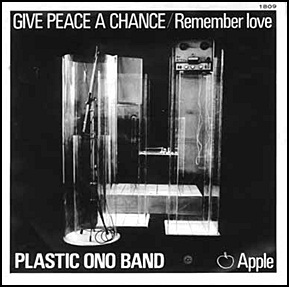
Plastic Ono Band: Give Peace A Chance

GPAC

On June 1, 1969, in room 1742, in “Queen Elizabeth Hotel”, in Montreal, Canada,  John Lennon and Yoko Ono recorded the song “Give Peace A Chance”. The song was written by Lennon and recorded by André Perry, using a simple setup of four microphones and a four-track tape recorder. Lennon played acoustic guitar, accompanied by Tommy Smothers from the “Smothers Brothers”, also on acoustic guitar. The recording session was attended by number of journalists and celebrities, including Petula Clark, Timothy Leary, Rabbi Abraham Feinberg, Joseph Schwartz, Rosemary Woodruff Leary, Dick Gregory, Allen Ginsberg, Murray the K and Derek Taylor. The song was released as a single by “Plastic Ono Band” on July 4, 1969 (UK), on “Apple” label. “Give peace a chance” became an anthem of the American anti-war movement during the 70’s.
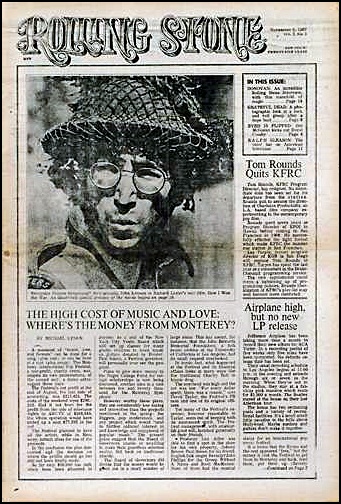
Rolling Stone Magazine First Number

RS

On November 9, 1967, the first issue of “Rolling Stone” magazine was published in San Francisco. The name of the magazine have been created from three sources: the Muddy Waters song, the first rock ‘n’ roll record by Bob Dylan and The Rolling Stones. The magazine was founded by Jann Wenner, who is still the magazine’s editor-in-chief, and music critic Ralph J. Gleason. The magazine became popular for its musical coverage and  for political reporting by Hunter S. Thompson. The first issue cover featured a photo of John Lennon, dressed in army fatigues from his recent movie “How I Won the War”.

The Beatles: Sgt. Pepper’s Lonely Hearts Club Band

12

On May 26, 1967, “Parlaphone” label released “Sgt. Pepper’s Lonely Hearts Club Band”, the eighth Beatles (The) studio album. It was recorded 24 November 1966 – 21 April 1967, at “EMI Studios” and “Regent Sound Studio” in London, and was produced by George Martin. The album is regarded as the first concept and art album in popular music. “Time” magazine described it as “a historic departure in the progress of music” It was an immediate commercial and critical success, winning four “Grammy Awards” in 1968, including “Album of the Year”, becoming the first rock album to receive this award. “Rolling Stone” magazine ranked “Sgt. Pepper’s Lonely Hearts Club Band” at number one in its list of the “500 Greatest Albums of All Time”. “Oxford Encyclopedia of British Literature” (Professor Kevin J. Dettmar) described it as “the most important and influential rock and roll album ever recorded”.

Personnel:

  • John Lennon– lead, harmony and background vocals; rhythm, acoustic and lead guitars; Hammond organ and final piano E chord; harmonica, tape loops, sound effects, and comb and tissue paper; hand claps, tambourine, maracas
  • Paul McCartney– lead, harmony and background vocals; bass and lead guitars; electric and acoustic pianos, Lowrey and Hammond organs; hand claps; vocalisations, tape loops, sound effects, comb, tissue paper
  • George Harrison– lead, harmony and background vocals, lead, rhythm and acoustic guitars, sitar; tambourine, harmonica, kazoo, hand claps, maracas
  • Ringo Starr– lead vocals, drums, congas, tambourine, maracas, handclaps and tubular bells, harmonica; final piano E chord
  • Sounds Incorporated– the saxophone sextet on “Good morning, good morning”
  • Neil Aspinall– tamboura, harmonica
  • Geoff Emerick– audio engineering; tape loops and sound effects
  • Mal Evans– counting, harmonica, alarm clock, final piano E chord
  • George Martin– tape loops, sound effects, harpsichord , harmonium, Lowrey organ, glockenspiel, Hammond organ , piano , final harmonium chord
  • Four French horns on “Sgt. Pep per’s Lonely Hearts Club Band”: Neill Sanders, James W. Buck, John Burden, Tony Randall,  arranged and conducted by George Martin and Paul McCartney,
  • String section and harp on “She’s leaving home”, arranged by Mike Leander and conducted by George Martin
  • Tabla, dilrubas, tamboura and swarmandalon “Within you without you”, played by members of the Asian Music Circle, with eight violins and four cellos arranged and conducted by George Harrison and George Martin
  • Clarinet trio on “When I’m Sixty-Four”: Robert Burns, Henry MacKenzie, Frank Reidy, arranged and conducted by George Martin and Paul McCartney
  • Saxophones on “Good morning, good morning”, arranged and conducted by George Martin and John Lennon
  • Forty-piece orchestra, including strings,  brass,  woodwinds, percussion; arranged by George Martin, John Lennon and Paul McCartney and conducted by George Martin and Paul McCartney.

Track listing

All tracks by John Lennon and Paul McCartney except where noted.

  1. Pepper’s Lonely Hearts Club Band
  2. With a Little Help From My Friends
  3. Lucy in the Sky With Diamonds
  4. Getting Better
  5. Fixing a Hole
  6. She’s Leaving Home
  7. Being for the Benefit of Kite
  8. Within You Without You – George Harrison
  9. When I’m Sixty Four
  10. Lovely Rita
  11. Good Morning Good Morning
  12. Pepper’s Lonely Hearts Club Band – reprise
  13. A Day in the Life