Tag Archives: July 6

Jethro Tull: A Passion Play

Passion Play

On July 6, 1973, “Chrysalis” label released “A Passion Play”, the sixth Jethro Tull studio album. It was recorded December 1972-January 1973,at “Château d’Hérouville”, in Val-d’Oise;  March 1973, at “Morgan Studios” in London, and was produced by Ian Anderson and Terry Ellis.

Personnel:

  • Ian Anderson – vocals, flute, acoustic guitar, soprano and sopranino saxophones
  • Martin Barre – electric guitars
  • John Evan – vocals, piano, organ, synthesisers
  • Jeffrey Hammond – narrator, bass guitar
  • Barriemore Barlow – drums, timpani, glockenspiel, marimba
  • David Palmer– orchestral arrangements
  • Robin Black – engineer
  • Brian Ward – photography

Track listing:

All tracks by Ian Anderson, except where noted.

  1. A Passion Play, Part I”

Act 1 – Ronnie Pilgrim’s funeral – a winter’s morning in the cemetery.

  • Lifebeats
  • Prelude
  • The Silver Cord
  • Re-Assuring Tune

Act 2 – The Memory Bank – A Small but Comfortable Theatre with a Cinema-Screen (the Next Morning).

  • Memory Bank
  • Best Friends
  • Critique Oblique

VIII.  Forest Dance #1

  1. A Passion Play, Part II

Interlude – The Story of the Hare Who Lost His Spectacles.

  • The Story of the Hare Who Lost His Spectacles – Ian Anderson, Jeffrey Hammond, John Evan

Act 3 – The Business Office of G. Oddie & Son (two days later).

  • Forest Dance #2
  • The Foot of Our Stairs
  • Overseer Overture

Act 4 – Magus Perdé’s Drawing Room at Midnight.

  • Flight from Lucifer
  • 10:08 to Paddington
  • Magus Perdé
  • Epilogue

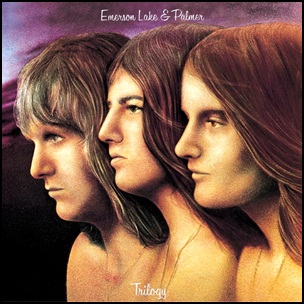
Emerson, Lake & Palmer: Trilogy

Trilogy

On July 6, 1972, “Island” label released “Trilogy”, the third Emerson, Lake & Palmer studio album. It was recorded October 1971 – January 1972, at “Advision Studios” in London, and was produced by Greg Lake.

Personnel:

  • Keith Emerson – Hammond organ C3, Steinway piano, Moog synthesizer III-C, Mini-Moog model D, Zurna
  • Greg Lake – vocals, acoustic and electric guitars, bass guitar
  • Carl Palmer – drums, percussion
  • Eddy Offord – engineer
  • Barry Diament – mastering
  • Hipgnosis – design

Track listing:

  1. The Endless Enigma (Part One) – Keith Emerson, Greg Lake
  2. Fugue – Keith Emerson
  3. The Endless Enigma (Part Two) – Keith Emerson, Greg Lake
  4. From the Beginning – Greg Lake
  5. The Sheriff – Keith Emerson, Greg lake
  6. Hoedown – Aaron Copland, arr. Keith Emerson, Greg Lake, Carl Palmer
  7. Trilogy – Keith Emerson, Greg Lake
  8. Living Sin – Keith Emerson, Greg Lake, Carl Palmer
  9. Abaddon’s Bolero – Keith Emerson


MC 5: High Time

High Time

On July 6, 1971, “Atlantic” label released “High Time”, the second MC5 studio album. It was recorded September–October 1970,  at “Artie Fields Studios” in Detroit, ”Lansdowne Studios” and “Pye Studios” in London, and was produced by Fred Smith, Wayne Kramer, Dennis Thompson, Rob Tyner and Geoffrey Haslam.

Personnel:

  • Fred “Sonic” Smith – vocals, guitar, harmonica, organ, sandpaper
  • Wayne Kramer– vocals, guitar, piano
  • Michael Davis – vocals, bass
  • Dennis Thompson – vocals, drums, tambourine, tamboes, acme scraper, percussion
  • Rob Tyner– vocals, harmonica, maracas, rockas, castanets, congas
  • Pete Kelly – piano
  • Skip Knapp – organ
  • Butch O’Brien – bass drum
  • Bob Seger– percussion
  • Dave Heller – percussion
  • Kinki Lepew – percussion
  • Dave Morgan – percussion
  • Scott Morgan– percussion
  • Ellis Dee – percussion
  • Bobby Wayne Derminer – wizzer
  • Marlene Driscoll – vocals
  • Joanne Hill – vocals
  • Brenda Knight – vocals
  • Charles Moore – vocals, flugelhorn
  • Leon Henderson – tenor saxophone
  • Rick Ferretti – trumpet
  • Dan Bullock – trombone
  • Larry Horton – trombone
  • David Oversteak – tuba

Track listing:

  1. Sister Anne – Fred “Sonic” Smith
  2. Baby Won’t Ya – Fred “Sonic” Smith
  3. Miss X – Wayne Kramer
  4. Gotta Keep Movin’ – Dennis Thompson
  5. Future Now – Rob Tyner
  6. Poison – Wayne Kramer
  7. Over and Over – Fred “Sonic” Smith
  8. Skunk (Sonicly Speaking) – Fred “Sonic” Smith

Louis Armstrong

On July 4, 1971, Louis Armstrong died aged 69. He was musician  (trumpet) and singer, brought various inventions in jazz music, including shifting the focus from collective improvisation to solo performance, bringing improvisation to singing (scat singing) and “reviving” the stage performance with charismatic and expressive stage presence. Armstrong became one of the first African-American artists that were popular among wide “white” audience. His influence extended far beyond jazz music and he is regarded as one of the most influential  artists in the history of the 20th Century popular music.